


Pablo Picasso and Antiquity 16 September – 15 October 2023
Exhibition Prince's Palace, Monaco Almine and Bernard Ruiz-Picasso Foundation
Renowned for his contributions to modern art, Pablo Picasso frequently drew upon the heritage of ancient Greece and Rome throughout his career. This engagement manifested in both style and subject matter: mythological figures, Classical compositions, and naturalistic visual idioms were abundant in the artist's prolific body of work, which spanned almost eight decades. Picasso was first introduced to the works of Classical artists in the late 19th century during his studies in the academic tradition. His early encounters with these works were primarily through black and white reproductions or casts, which presented Classicism as a colourless and relatively refined aesthetic. At that time, art academies championed Classicism as a cohesive style worthy of imitation and urged students to adopt what they perceived as the inherent formal clarity, visual harmony, and compositional balance of Classical art – all of which were considered to convey the soundness and ideological purity of Greco-Roman civilisations.
However, this portrayal was highly mediated and often skewed to reflect an idealized notion of the Classical past as the foundation of modern Western culture. When Picasso visited archaeological sites in Rome, Naples, Pompeii, and Herculaneum in 1917 as the First World War ravaged Europe, he was confronted with aspects of ancient Greek and Roman visual culture that his academic training had omitted: colourful wall paintings, fragmented sculptures, eroded surfaces, and buried buildings stood in these once powerful yet dilapidated urban centres. These ruins provided a corrective to the alleged coherence and imperviousness of Classical culture and encouraged Picasso to understand its legacy in terms of rupture rather than integrity.
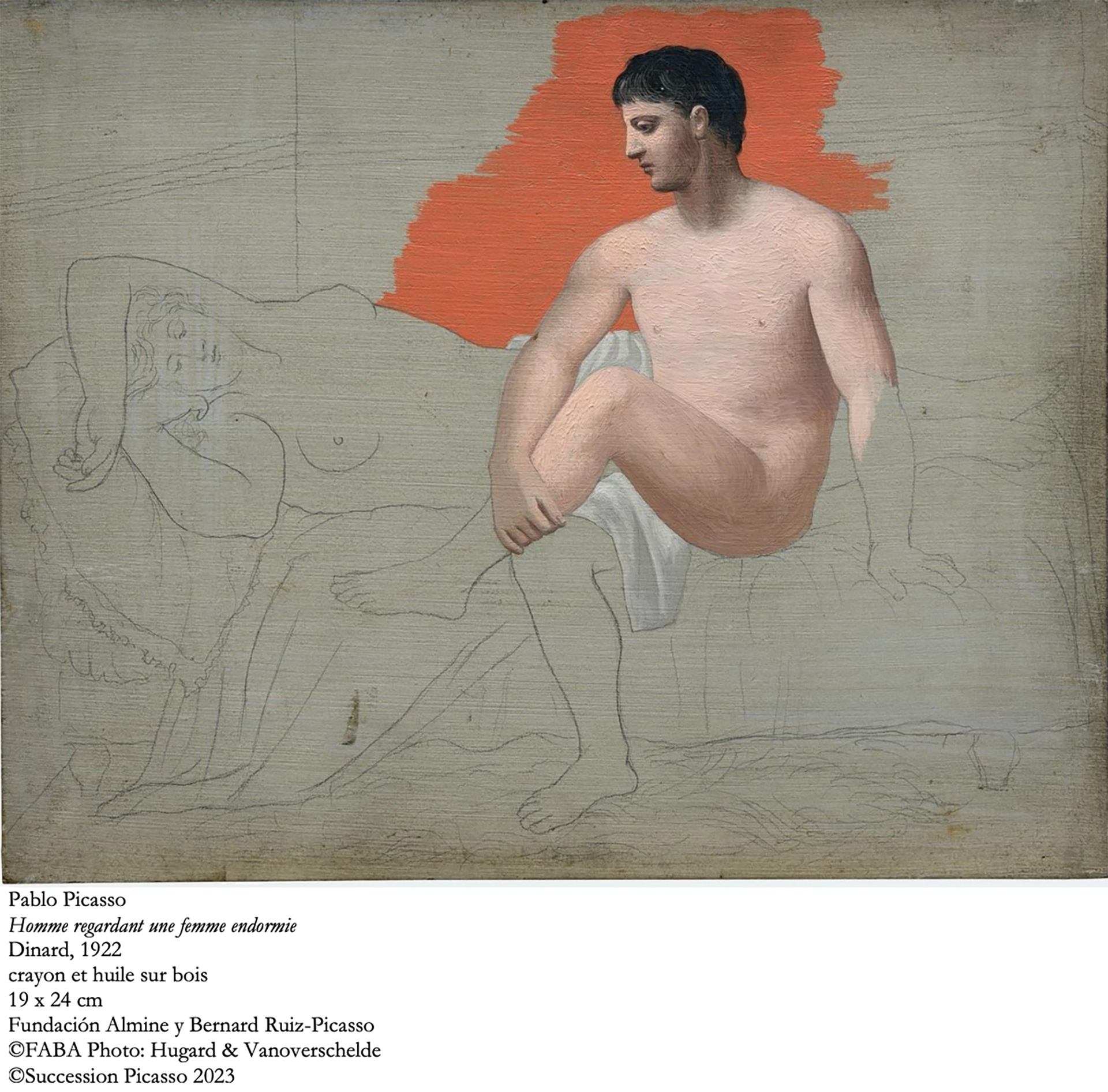
This exhibition proposes that Picasso’s close encounter with Classical vestiges in Italian archaeological sites informed a generative approach to Classicism that foregrounded notions of erasure, resilience, and recovery in the face of environmental, social, and political change. Following his travels to Italy, Picasso frequently referenced Greco-Roman artworks through his adoption of a classicising style and depictions of mythological subjects, as well as through representations of isolated limbs reminiscent of antique sculptures and eroded, sedimented surfaces evoking ancient wall paintings. In these ways, the artist redefined the visual heritage of the Classical world as a recognisable, yet fluid compendium of partial images to be recovered, reinterpreted, and reconstructed.
Installed alongside the newly restored 16th-century frescoes of the Palais Princier in Monaco and featuring selections from the collection of the Fundación Almine y Bernard Ruiz-Picasso (FABA), and a painting from the Nahmad Collection, Pablo Picasso and Antiquity provides a platform for Picasso’s insights into the survival, legibility, and transformability of ancient artefacts despite historical disruption and material distress. The exhibition explores themes of ruin and decline as well as endurance and renewal in relation to Picasso’s distinctive interpretations of Classicism in a variety of mediums from the post-WWI period to the 1950s. In doing so, it illuminates the radical ways in which the artist reimagined the heritage of the Greco-Roman world through subjects, style and materials, as he defied the dogmatism and idealism of the academic tradition.
Pablo Picasso and Antiquity is organised by the Fundación Almine y Bernard Picasso and curated by Francesca Ferrari, with exhibition design by Cécile Degos. The exhibition is part of the international collaboration Picasso Celebration 1973-2023 on the occasion of the 50th anniversary of Pablo Picasso’s death.