



Pablo Picasso and Antiquity 16 September – 15 October 2023
Prince's Palace Exhibition, Monaco Almine and Bernard Ruiz-Picasso Foundation
Pablo Picasso, an undisputed protagonist of modern art, was throughout his career interested in the legacy of ancient Greek and Roman cultures. He referred to them on numerous occasions, both in terms of style and subject matter: mythological figures, classical compositions and naturalistic visual idioms abound in the artist's prolific work, which spans nearly eight decades. It was at the end of the 19th century, as he began his academic training, that he discovered works of classical art through black and white reproductions or plaster casts, which gave them a colourless yet elegant aesthetic.
At this time, art academies advocated for the imitation of classicism, making it a coherent style and encouraging students to conform to what they saw as a model of formal clarity, visual harmony, and balanced composition. The aim was then to promote a taste for rigor and ideological purity considered the preserve of Greek and Roman civilisations.
The perception of the foundations of modern Western culture had been elaborated from a vision of classical Antiquity, a vision that was as widespread as it was distorted and highly idealised. When, in 1917, as the First World War ravaged Europe, Picasso visited the archaeological sites of Pompeii and Herculaneum as well as the ancient cities of Naples and Rome, he was confronted with aspects of Greco-Roman art from Antiquity that his academic training had largely passed over: colourful murals, fragmented sculptures, eroded surfaces, and buried buildings appeared in these once-powerful cities, which he now saw as abandoned. The spectacle of these ruins then called into question the regularity and supposed imperviousness of classical art and led Picasso to reconsider this heritage from a perspective of rupture rather than integrity.
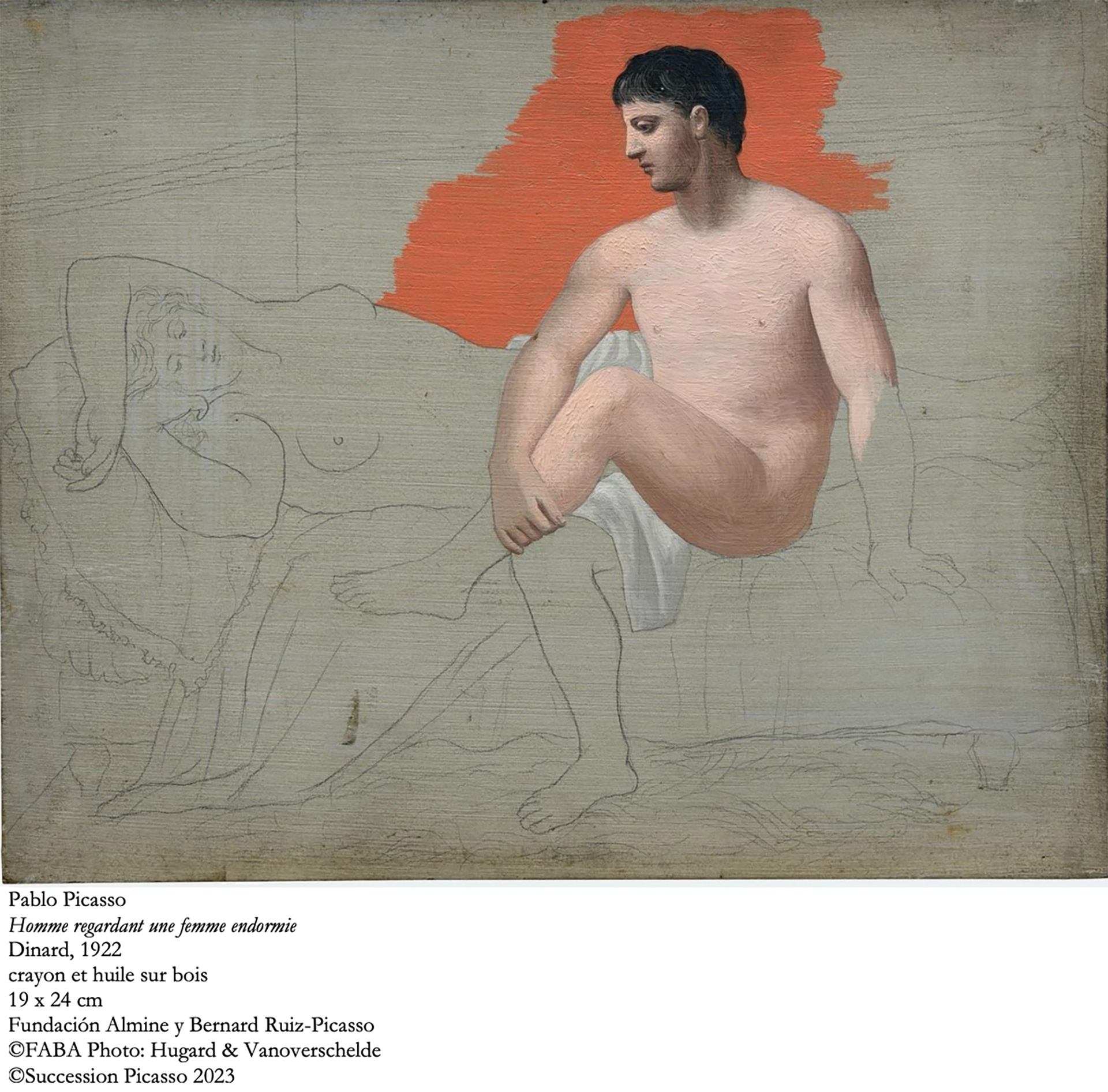
This exhibition suggests that Picasso's privileged encounters with the remnants of Greco-Roman antiquity at Italian archaeological sites allowed him to approach classical antiquity through the notions of erasure, resilience, and recovery in the face of environmental, social, and political changes. Following his travels in Italy, Picasso frequently referenced the art of ancient Greece and Rome, both by adopting styles of classical inspiration and by depicting mythological scenes, isolated limbs evoking Greco-Roman statuary, or eroded and sedimented surfaces, similar to ancient wall paintings. Thus, Picasso presented the iconographic heritage of classicism as a collection of fragmented images that not only needed to be rediscovered and deciphered but also revisited and reinvented.
Held in the Palais Princier in Monaco, alongside the recently restored 16th-century frescoes, the exhibition focuses on a selection from the collection of the Fundación Almine y Bernard Ruiz-Picasso (FABA), as well as a painting from the Nahmad Collection. «Pablo Picasso and Antiquity» provides a stage for Picasso's thoughts on the survival, legibility and malleability of ancient artefacts, beyond the upheavals of history and the degradation of objects. The exhibition explores the themes of ruin and decline, but also those of resilience and renewal. In this way, it resonates with the way in which Picasso, from the immediate aftermath of his Italian trip to his Mediterranean residences in the 1940s and 1950s, approached the legacy of Greco-Roman antiquity through a variety of media. Pablo Picasso and Antiquity« highlights the radical ways in which the artist rethought the legacy of the classical world in terms of subject, style and materials, rejecting the dogmatism and idealised vision of the academic tradition.
« Picasso and Antiquity » is an exhibition organised by the Almine y Bernard RuizPicasso Foundation, curated by Francesca Ferrari and designed by Cécile Degos. It is part of the international collaboration « Celebration Picasso 1973-2023 », which marks the 50th anniversary of Pablo Picasso's death.